
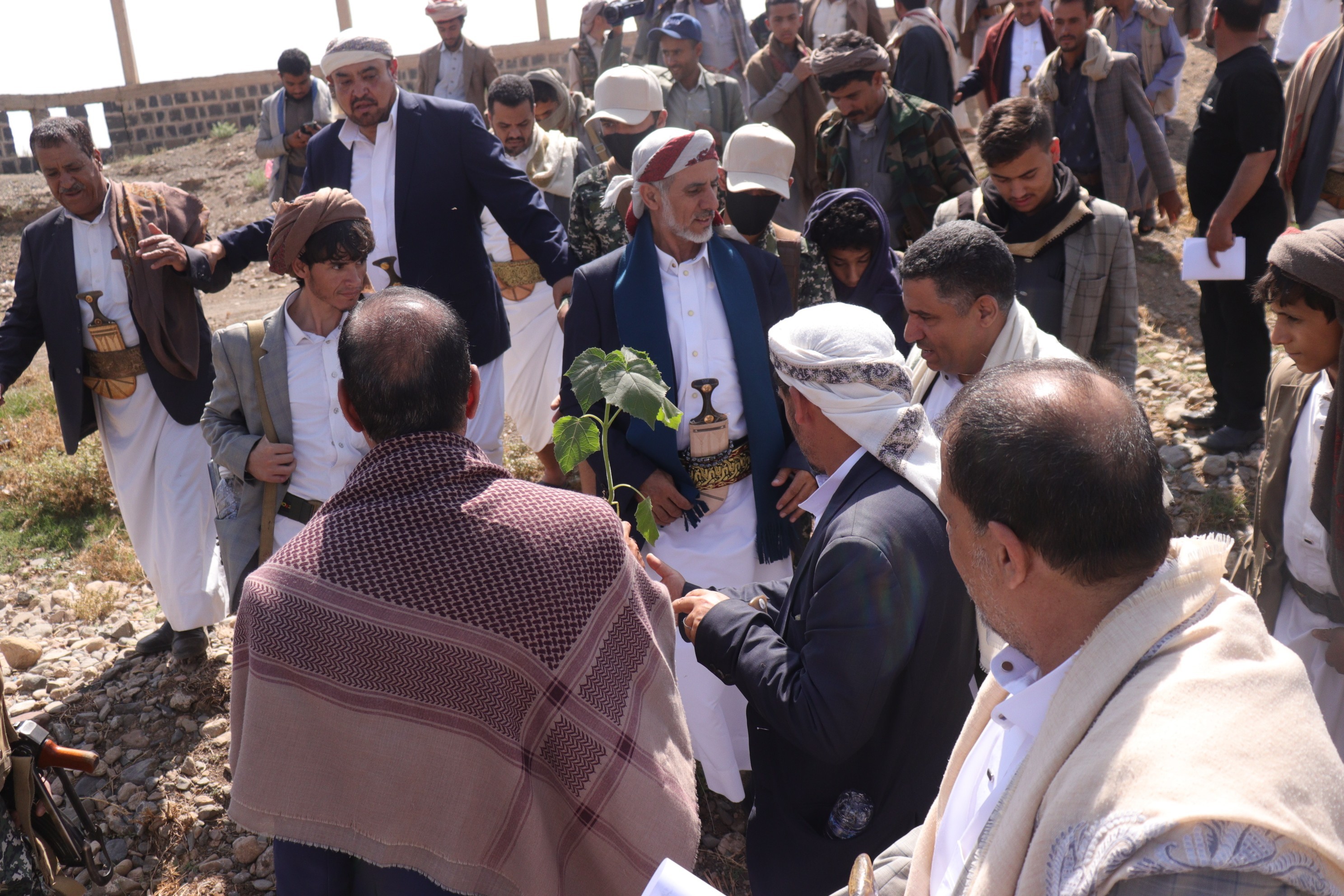
Today, Acting Prime Minister Muhammad Muftah inaugurated the project to plant ten thousand paulownia tree seedlings, the first phase.
Sanaa - Sheba:
Today, Acting Prime Minister Muhammad Muftah inaugurated the project of planting ten thousand seedlings of Paulownia trees, the first phase, in the Bani Al-Harith District in the capital secretariat, under the slogan “For a pure environment and sustainable economic assets,” with local funding.
The scholar Muftah, along with the Acting Minister of Agriculture, Fisheries and Water Resources, Ammar Al-Karim, the Mayor of the Capital, Dr. Hammoud Abbad, and the Deputy Minister of Electricity, Energy and Water, Adel Bader, planted a number of paulownia tree seedlings in the Al Rahba area.
The project aims to expand the cultivation of paulownia trees to produce wood, by investing treated wastewater in growing woody trees instead of growing direct-use crops that harm human health.
The project, which costs eight million riyals and is funded by the local council in the capital secretariat through the Agricultural and Fisheries Projects and Initiatives Financing Unit, targets 250 farmers during the year 1447 AH in the areas of Beit Al-Hilli, Beit Hanzal, Beit Qahim, Beit Al-Khawi, Beit Al-Hanbasi and Al-Qamasi, and Beit Rassam and Dar Haroun in Bani Al-Harith.
The project is implemented by the Bani Al-Harith Multi-Purpose Cooperative Society under the supervision of the General Administration of Forests, Pastures and Desertification Control, and the follow-up and evaluation of the agricultural, fisheries and water resources sector in the capital secretariat.
The scholar Muftah, Al-Karim, Abbad, and Bader, along with members of the Shura Council, Adel Al-Hanbasi, First Undersecretary of the Capital Municipality, Khaled Al-Madani, and the heads of the two Social Affairs Committees - Deputy Head of the Development Team in the Secretariat, Hamoud Al-Naqeeb, and Planning Sharaf Al-Hadi, listened to clarifications from those concerned about the project and its positive impact on the targeted areas, farmers, and citizens in the Bani Al-Harith District.
The Acting Prime Minister confirmed that the inauguration of planting alternative trees for consumer crops in Wadi Al-Rahba, the sewage drainage route, comes within the framework of a comprehensive treatment of the sewage problem in the capital secretariat.
He said, "Today, it was approved to deepen a channel for untreated wastewater, and another channel for treated water, for sewage, and ten thousand seedlings of paulownia trees were approved as a first step, as alternative and quick crops that provide good returns to landowners and owners."
The scholar Muftah stated that there are other steps to address the problem of sewage on an ongoing basis, including preventing the irrigation of crops with untreated sewage water, and drilling surface hand wells in clean places, noting that the Municipality of the Capital will provide the people with a solar energy system for each surface well as soft loans.
He stated that among the remedies is preventing the waste of valuable groundwater that is drinkable in huge quantities and is sold to qat farmers in areas far from the Bani Al-Harith area, stressing that deterrent measures will be taken against anyone who violates this measure, whether they are well owners or those who participate in any way in supplying qat farms with well water.
He considered the measure absolutely necessary to preserve the region's important water basin from excessive depletion, pointing out that continued depletion of the basin in this way would lead to depriving residents of water in the near term.
The Acting Prime Minister added, "The greedy and greedy people who have wells must realize the danger of groundwater depletion and that we will not allow them to deepen the wells that are being depleted again, because they have become very deep and pose a danger to the water basin in general."
He continued, "Everyone must realize the dimensions of the problem, including well owners who must rationalize the use of water and direct it toward growing crops that consume less water and meet the needs of the population."
The scholar Muftah pointed out that the Government of Change and Construction is working on a strategy to address the wastewater problem, and it will be permanently moved from the current area, to a safer, wider area, far from the population and agricultural lands, stressing that the government is currently looking to provide sufficient funding to begin work as soon as it is available directly.
He continued, "The treatments that people are reassured about include the sewage channel for untreated wastewater by deepening it, so that it does not leak between citizens' lands, and ensuring the use of treated wastewater for non-food agriculture and paulownia trees and expanding their cultivation."
The Acting Prime Minister reiterated that the Capital Municipality will work to provide paulownia tree seedlings if citizens request a larger quantity of them and in sufficient numbers.
In turn, the Acting Minister of Agriculture, Fisheries and Water Resources explained that the implementation of the agricultural project will transform the targeted area in Bani Al-Harith into a forest of timber trees in addition to special fodder agriculture.
He pointed out that a number of measures will be implemented in the region to address the sewage problem, including digging alternative water wells from safe places, constructing crevasses to feed the water basin, and repairing the main sewage channel.
Ammar Al-Karim stated that the measures that will be taken come in cooperation between the government, society and the private sector, and their impact will be felt by everyone in the field, and they have been absorbed within the capital secretariat’s plan and the government’s serious approach.
Meanwhile, the Mayor of the Capital confirmed that the project comes within the framework of a comprehensive treatment of the wastewater problem, in accordance with short- and medium-term strategic visions that include multiple projects such as planting alternatives such as the paulownia tree, which can constitute a “wooden wealth.”
He pointed out that among the solutions to the sewage problem, in the targeted area of Bani Al-Harith, is the cultivation of fodder and the establishment of a group of wells, indicating that there is a matrix directed by the Acting Prime Minister so that each party bears its responsibility within the matrix to address the problem of sewage discharge within the framework of an urgent and strategic time program.
The inauguration was attended by the secretariat’s agents, Engineer Abdul Karim Al-Houthi and Muhammad Saree, the assistant Dr. Abdul-Wahab Sharaf al-Din, the Secretary-General of the Agricultural Cooperative Union, Engineer Muhammad al-Qahum, the executive director of the Agricultural and Fisheries Projects and Initiatives Unit in the secretariat, Abdullah Sharaf al-Din, the directors of the local water and sanitation corporation, Engineer Muhammad Mada’as, the Bani al-Harith Directorate, Hamad bin Rakan, and officials of the Bani al-Harith Cooperative Society.