
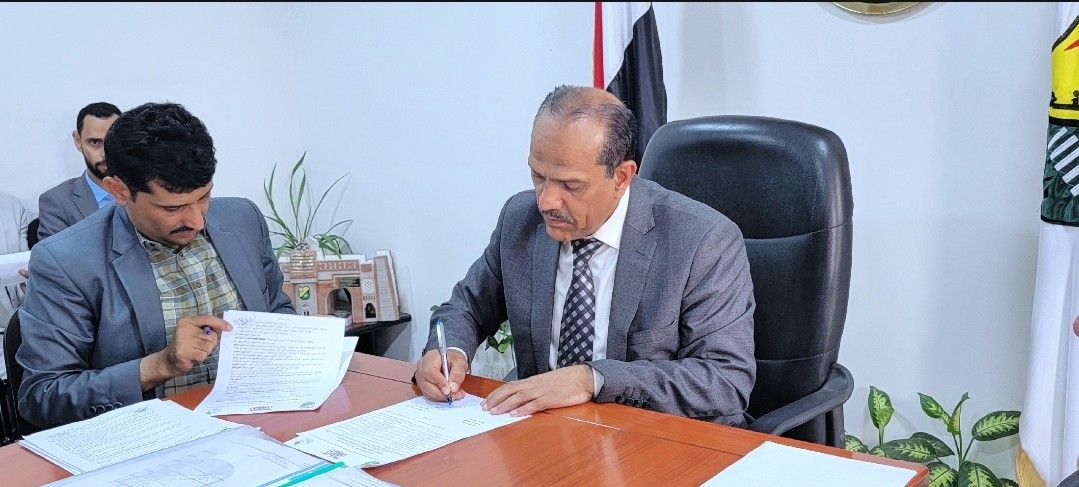
In a qualitative step towards promoting sustainable development and achieving self-sufficiency, Sana’a University today signed a strategic partnership agreement with the Agricultural and Fisheries Projects and Initiatives Financing Unit in the capital secretariat.
In a qualitative step towards promoting sustainable development and achieving self-sufficiency, Sana'a University today signed a strategic partnership agreement with the Agricultural and Fisheries Projects and Initiatives Financing Unit in the capital secretariat.
This partnership aims to unify the academic and research expertise of Sana'a University with the executive capabilities of the government sector, thus contributing to building a prosperous future based on knowledge and innovation.
The agreement focuses on a number of basic axes, the most prominent of which are:
1. Directing applied scientific research to support economic empowerment projects that contribute to improving livelihoods.
2. Providing the necessary technical support and training to qualify specialized cadres and enable them to implement pioneering projects.
3. Creating sustainable job opportunities through supported projects, opening new sources of income for citizens.
4. Developing productive capacities in the agricultural and fishery sectors, to enhance food security at the level of Amanat Al-Asimah and Yemen in general.
On this occasion, the President of Sana’a University, Professor Dr. Muhammad Ahmed Al-Bukhaiti, stressed the importance of the partnership, thanking the Mayor of the capital, Dr. Hammoud Abbad, and his work team for “their great interest in achieving this cooperation and bringing it to reality.”
For his part, the Executive Director of the Finance Unit, Engineer Abdul-Malik Al-Ansi, explained that this partnership represents an opportunity to benefit from Sana’a University as a “national expertise house” to achieve local development in the agricultural and fisheries sectors, and to support economic empowerment projects.
This cooperation is a unique model between the academic and executive sectors, and an important step towards enhancing food security and effectively employing national competencies, ensuring a better future for future generations.