
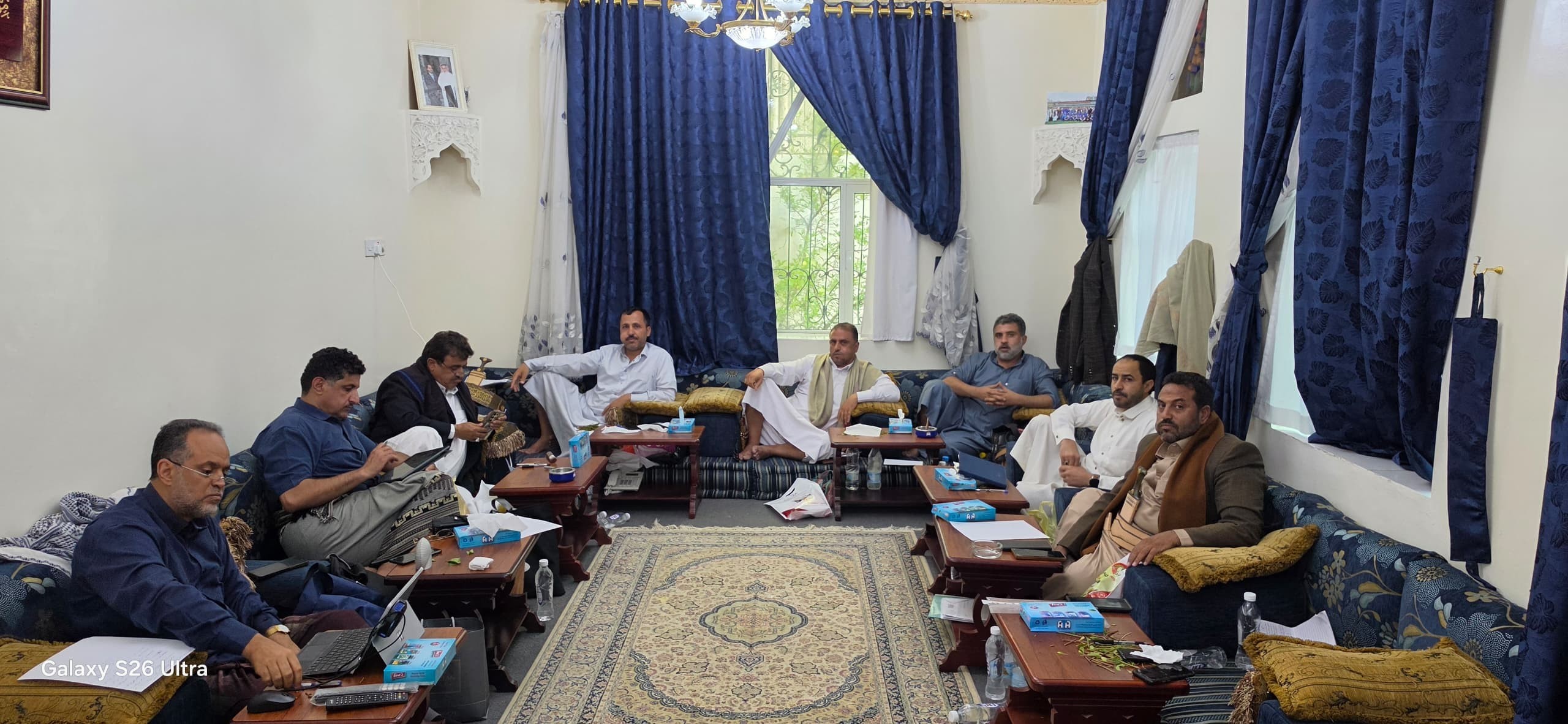
Today, the development and cooperative work management and implementation team in the capital secretariat, headed by the team’s deputy head, Hammoud Al-Naqeeb, discussed mechanisms for enhancing economic empowerment and supporting local production, within the framework of directions aimed at achieving self-sufficiency and promoting sustainable development.
Sanaa - Sheba:
Today, the development and cooperative work management and implementation team in the capital secretariat, headed by the team’s deputy head, Hammoud Al-Naqeeb, discussed mechanisms for enhancing economic empowerment and supporting local production, within the framework of directions aimed at achieving self-sufficiency and promoting sustainable development.
The meeting, which included the Secretariat’s Secretariat for the Financial Sector, Mazen Noman, and Agricultural Affairs, Muhammad Saree, and the Executive Director of the Agricultural and Fisheries Projects and Initiatives Financing Unit, Abdullah Sharaf al-Din, and officials from the planning sectors, Dr. Abdul Wahab Sharaf, and Agriculture, Muhammad Hajer, the Director of Social Affairs, Nasser al-Kahli, and the Deputy Director of the Unit, Samir Hamza, reviewed the results of the visit of the leadership and members of the development team to Hodeidah Governorate to see a number of successful development and production experiences.
The meeting discussed a number of initiatives and studies, including a study by the Executive Agricultural Unit on establishing cotton factories, in addition to mechanisms for marketing local products, working to develop brands capable of competing in the markets, marketing them in commercial centers, and strengthening partnerships with the private sector.
He touched on the efforts made to form cooperative societies at the level of the capital secretariat, and the implementation of a number of training courses and workshops, in addition to reviewing successful experiences in Hodeidah Governorate, in a way that enhances the development of cooperative work and expands its scope.
The team's deputy head, the captain, stressed the importance of economic empowerment at this stage, pointing out that the transformations the country is witnessing require building a national economy based on production, and strengthening the role of society in various fields, which contributes to supporting national steadfastness.
He explained that the transition towards a productive society is a strategic choice, and that agriculture represents the basic pillar of the national economy, pointing to the successes achieved in reducing import bills for a number of value chains, including poultry, dates, cows, and garlic, leading to achieving self-sufficiency in some of them.
The captain pointed out the necessity of completing the rest of the value chains, strengthening the role of the local authority in supporting economic empowerment programs, and activating cooperative work, which contributes to improving the standard of living and creating sustainable job opportunities.
For his part, the Financial Sector Undersecretary, Noman, reviewed a study on the economic empowerment of productive families, which included work models between the government and cooperative societies, in addition to partnership with the private sector, and focused on the importance of mobilizing the local community, contributing to reducing poverty, and enhancing the social responsibility of the private sector.
He pointed out the importance of establishing training and qualification centres, developing existing industries such as tanneries, organizing them, and raising their production efficiency, in addition to completing field surveys of available opportunities and capabilities.
The meeting came out with a number of recommendations, including preparing detailed reports from relevant authorities on the projects implemented and under implementation and future plans, evaluating the results of agricultural exhibitions and festivals, in addition to preparing to hold an expanded meeting in the presence of a number of relevant authorities.
This meeting comes within the framework of the periodic meetings held by the team in the capital secretariat to follow up on the implementation of development and cooperative action plans, and to strengthen community partnership in order to serve the achievement of sustainable development.