
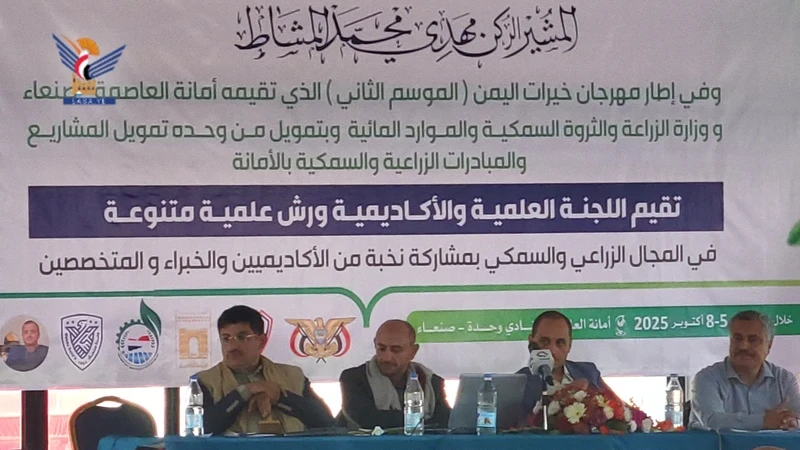
Today, a scientific symposium was held in Sana’a entitled “Small and Micro-enterprises and their Role in Agricultural Advancement and Increasing Agricultural Productivity” within the framework of the activities of the Yemen Bounties Festival in its second season in Amanat Al-Asimah. The symposium aimed to highlight the importance of small and micro enterprise development
Sanaa-Sheba:
Today, a scientific symposium was held in Sana’a entitled “Small and Micro-enterprises and their Role in Agricultural Advancement and Increasing Agricultural Productivity” within the framework of the activities of the Yemen Bounties Festival in its second season in Amanat Al-Asimah.
The symposium aimed to highlight the importance of developing small and micro-enterprises, especially in light of the deteriorating economic situation and the worsening indicators of poverty and unemployment, clarifying the damage caused by the aggression and blockade on the agricultural and fisheries sector, and developing solutions, proposals and recommendations to advance the sector.
In the symposium, which was attended by Assistant Undersecretary Ismail Al-Jarmouzi, and moderated by the Chairman of the Festival’s Scientific Committee, Dr. Mustafa Atif, and the Chairman of the Academic Committee, Dr. Abdul-Wahab Sharaf Al-Din, four working papers were presented. The first and second, presented by the Head of the Department of Agricultural Economics at the Faculty of Agriculture at Sana’a University, Dr. Khaled Qassem, reviewed the role of small and smaller projects in increasing agricultural productivity, and the challenges and problems facing these projects.
They touched on the reality of small and micro agricultural projects, their role in providing food, plant and animal products, and the opportunities available to them.
The two papers confirmed that the agricultural and fishery sectors are promising sectors that offer broad opportunities for small and micro-enterprises, providing many natural agricultural and fisheries resources, in addition to the existence of a number of opportunities and sources of financing for these projects.
They pointed to the structural composition of the agricultural sector in Yemen, which is based on plant and animal crops, which represent a stock for small and micro-enterprises, especially the plant sector, which is divided into seven groups: “grains, vegetables, fruits, leguminous crops, cash crops, fodder, and qat.”
They explained that the animal sector is based on raising “sheep, goats, cows, and camels” and their derivatives of meat, dairy, cheese, leather, and wool, in addition to honey products, and their concentration in the countryside, which is the large and promising storehouse for small and smaller projects, in addition to the fish sector?
The two papers reviewed the policies and efforts made regarding the small and micro enterprises sector, and the initiatives included in the national vision for building the modern Yemeni state, as well as benefiting from pioneering experiences in the field of small projects, most notably the Korean, Japanese, and Indian experiences.
They also presented the opportunities available in the agricultural, livestock and fishery sectors, through more than fifty opportunities for small and micro-enterprises, as well as a number of opportunities and sources of financing for agricultural projects, the difficulties and challenges they face, and the experiences of a number of developing and developed countries that have succeeded and developed thanks to their reliance on small and micro-enterprises.
While the third paper presented by Dr. Muhammad Al-Nafish and Dr. Ashraf Al-Asbahi reviewed project management as a strategic tool to enhance climate resilience in the agricultural sector towards achieving sustainable development goals, and a quick overview of the dual challenges in the agricultural sector.
In the presence of representatives of a number of concerned and relevant authorities, the symposium included interventions and discussions about the difficulties and problems facing opportunities and sources of financing small and micro-enterprises in the agricultural sector, and the necessity of keeping pace with technological innovations in agricultural projects.